How the collection was prepared for search.
This page documents the technical work behind MTL Archives, from municipal source datasets to search, visual browsing, and editorial interfaces.
The metrics on this page come from dated reports and saved artifacts. They describe specific runs, not a general performance promise.
One public collection, several working layers.
MTL Archives began with open photographic datasets from the City of Montréal. The images were available, but the records, files, and identifiers were not yet a practical basis for research.
The work linked records to files, preserved source references, added derived information in separate fields, and indexed text and images for more than one search mode.
The starting material was digitized. It was not uniform.
The inspected manifests contain JPG, TIFF, and a small number of PDF files, along with names, descriptions, dates, credits, cotes, and source URLs. Fields are not consistently populated. Some titles look like file codes, and records from different datasets can point to the same image.
City of Montréal photographic and aerial photothèque datasets
7,945 JPG, 6,875 TIFF, and 2 PDF files in the working manifest
Name, description, date, credit, cote, source URL, portal match
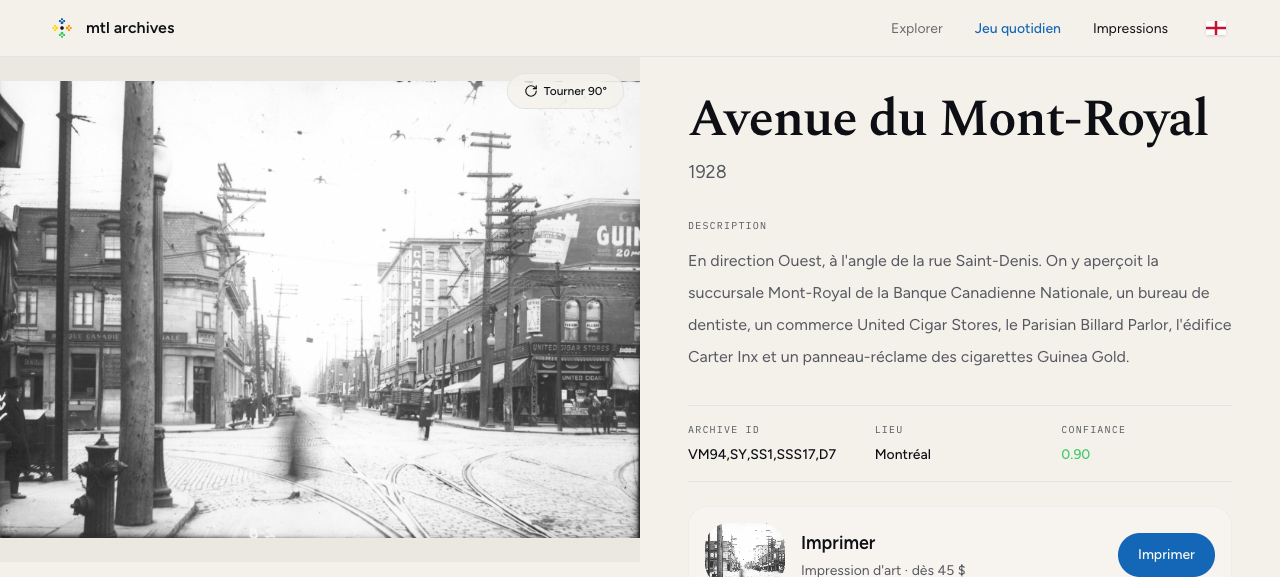
mtl_archives_metadata_0.json
Rue Saint-Antoine
Décennie 1920
En direction Est, à l’angle de la rue Saint-David (aujourd’hui disparue). On y aperçoit l’Édifice de The Gazette Printing Co ainsi que des panneaux-réclames de Magic Baking Powder et JJ Joubert Limitée.
VM94,SY,SS1,SSS17,D1
Archives de la Ville de Montréal
depot.ville.montreal.qc.ca/phototheque-archives/jpeg/VM94-Z2.jpg
Record extracted from manifest_search_canonical.jsonl. The accents and punctuation are retained here to show source content, not a new description.
Linking records, files, and identifiers.
Ingestion downloads catalogues in batches, normalizes fields, associates records with images, and produces a canonical manifest. Duplicates are not removed without a trace. Source identifiers remain attached to the production result.
- 01
Ingest
Download catalogues and associated files.
- 02
Normalize
Standardize fields while retaining original values.
- 03
Associate
Link records, images, and source URLs.
- 04
Deduplicate
Keep one production record and document duplicate relationships.
Total in the January 8, 2026 reconciliation run.
Unique records after deduplication in that run.
Difference between input records and unique records in that run.
The source record and derived observations are different objects.
Original identifier and cote
Original title and date
Description and credit
Institutional source URL
OCR where text is present
Generated caption with model and status
Text and image representations
Geographic and taxonomy fields where available
The principle is straightforward: enrich a record without presenting a machine observation as an archival description. Migrations and API responses retain caption provenance, model, and status fields.
A full run, with its failures visible.
The May 2026 VLM report contains 14,822 input rows. 14,706 received a caption. 14,627 outputs met the expected structure. The 79 structurally invalid outputs and 116 image or model errors remain counted separately.
99.2% of the rows in this recorded run.
98.7%. Structural validity does not establish historical accuracy.
Estimate from a recovered A10 run, not a billing measurement.
The report reconstructs the first 12,100 rows from saved chunks, then resumes the remaining 2,722. No complete historical per-record cost is retained in the available artifacts.
Indexes connect preparation work to the interface.
Preparation runs outside the public interface. The Worker receives a query, calls the available retrieval branch, hydrates returned identifiers from the database, and returns results with their retrieval source.
- 01
Source records
identifiers, titles, descriptions, credits
- 02
Normalized corpus
linked and deduplicated manifests
- 03
Representations
enriched text and image vectors
- 04
Indexes
metadata search, semantic retrieval, visual similarity
- 05
Interfaces
public search, browsing, explorer, editorial tools
For cotes, titles, and exact fields.
For comparing a text query with indexed text fields.
For comparing an image with saved CLIP vectors.
Testing language that exact fields do not express directly.
These queries returned results from the public semantic search on September 21, 2026. They illustrate retrieval behavior. They are not archival descriptions of the records.
Search, inspect sources, and build a collection.
The live Explorer supports semantic and visual search; its 2D/3D map displays a separate snapshot of 14,715 points, so some results can remain in the list without appearing on the map. The responsive view uses date colors, a legend, and decade emphasis. Researchers can inspect sources, copy citations, save a collection locally, export CSV or JSON, and inspect 20 snapshot-similarity neighbors. The displayed count is separate from the dated 13,499-record production corpus. The snapshot model and date are unknown, and proximity is not proof of geographic relation or historical subject similarity.
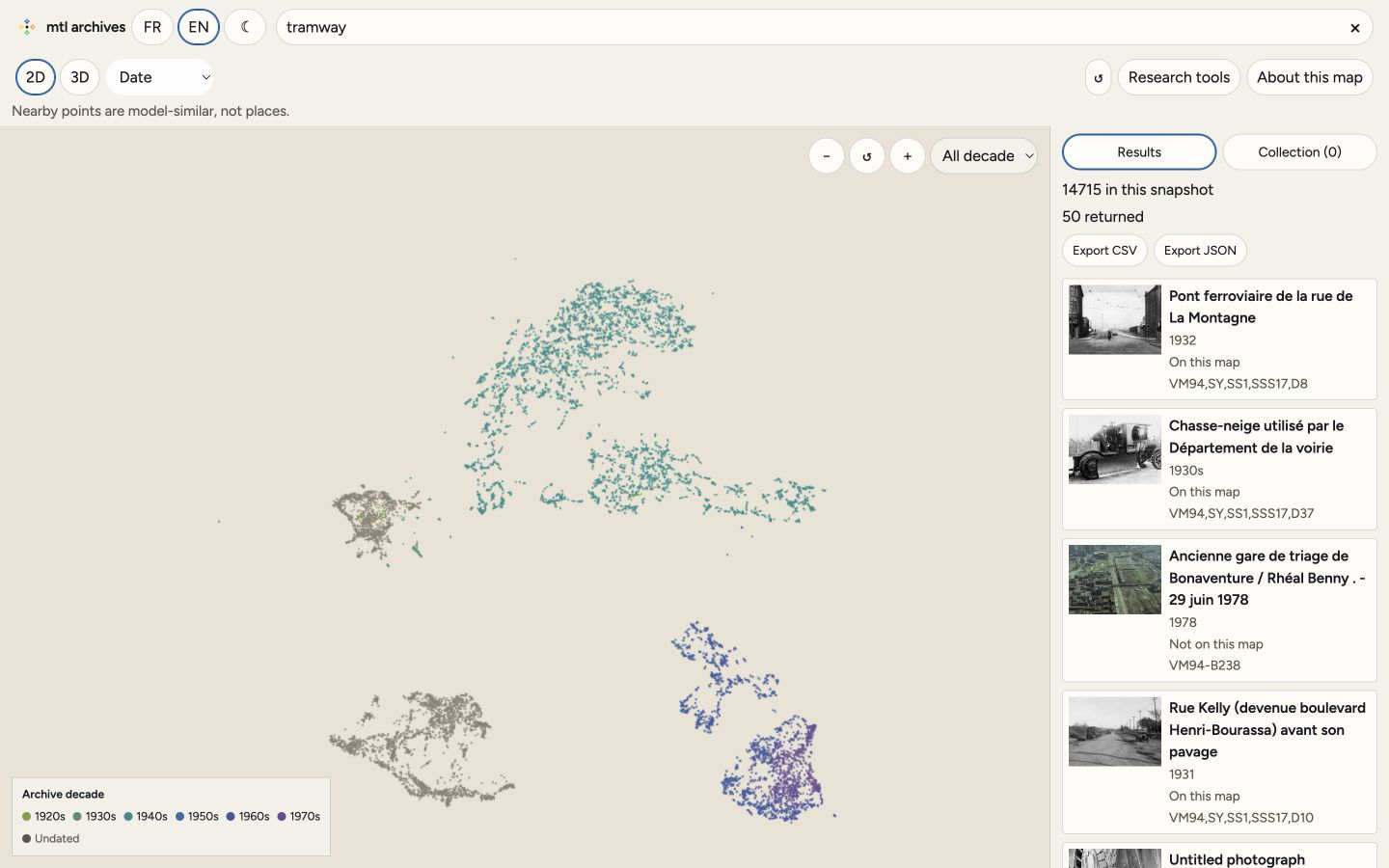
Live Explorer workspace in light theme: a query, date-colored 2D image map with legend, and a results list with source titles and references.
The pipeline feeds tools people use.
The work does not stop at the index. The same identifiers and files support several interfaces, each with a different purpose.
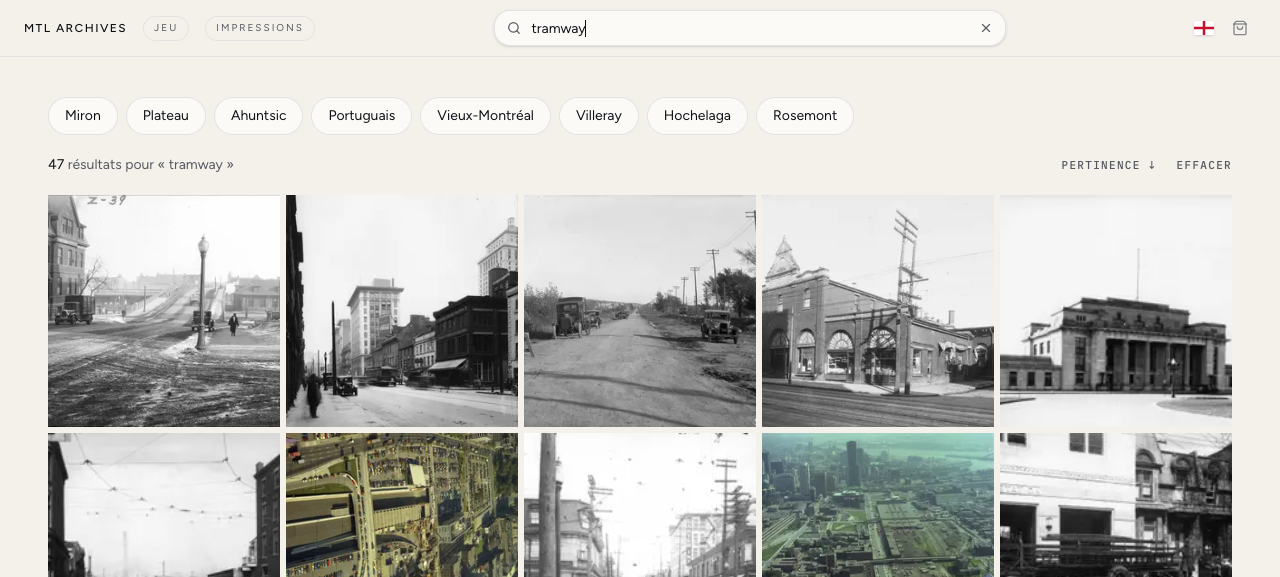
Text queries, results, records, and source links.
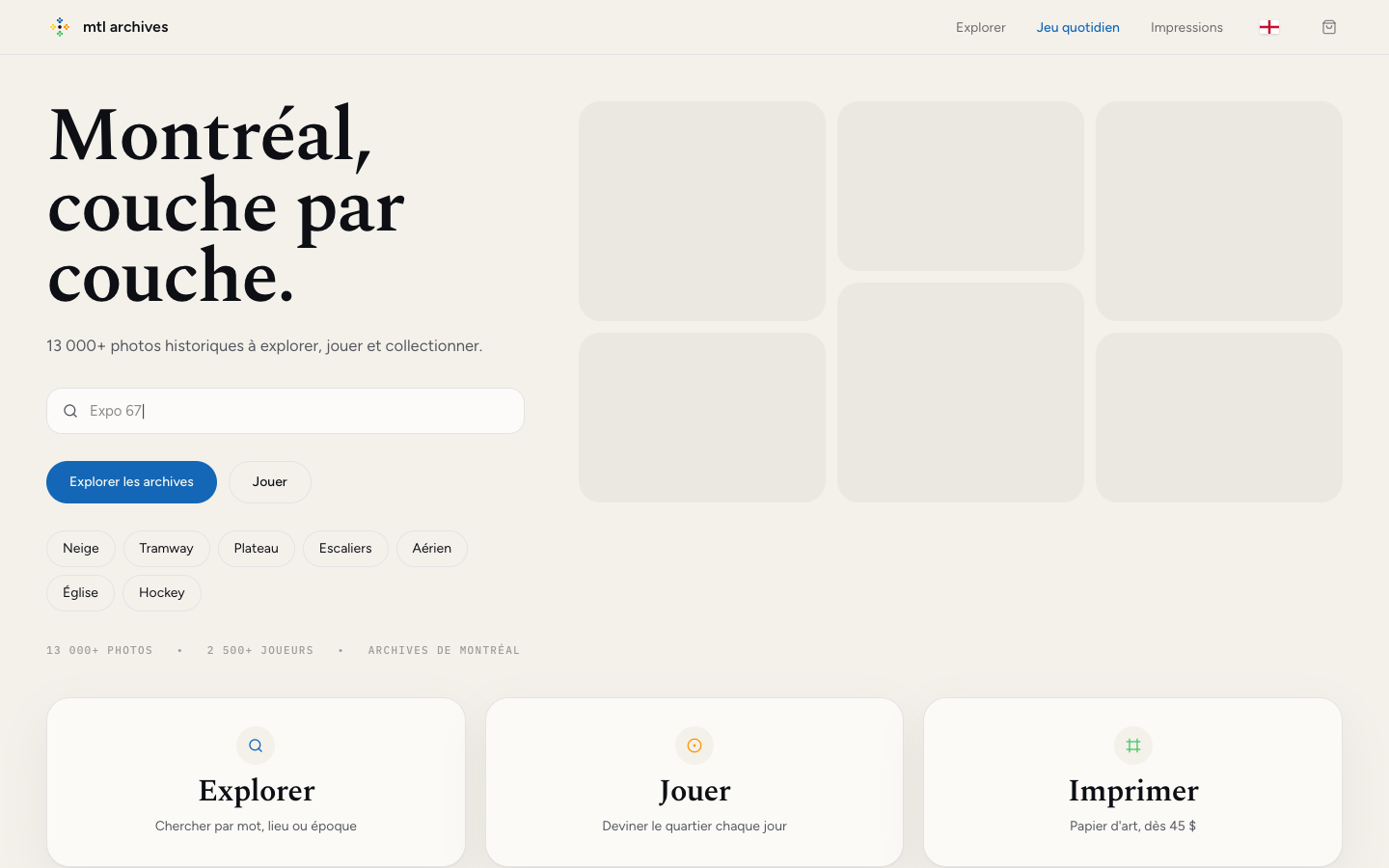
Browsing, search, a daily game, and print ordering.
Semantic and visual search, a 2D/3D view, source details, local collections, and CSV/JSON export.
What is preserved, what is added, and what remains uncertain.
Original identifiers, credits, cotes, and source URLs remain attached to records. Generated captions have a source, model, and status. Repair and rollback procedures are documented. MTL Archives enrichment should not be described as curator-approved.
Identifiers, titles, dates, descriptions, credits, cotes, and source URLs.
OCR, captions, image representations, taxonomy, and coordinates where available.
Caption status, model information, generation source, and documented revisions.
A Provenance implementation can add review, correction, approval, or rejection before reuse.
What the artifacts do not yet measure.
- 01
Historical cost per record or batch, because no retained billing export was found.
- 02
Production p50 and p95 latency, because no representative time series was found.
- 03
Acceptance, correction, or review-time rates, because no complete review-event dataset exists.
- 04
Research time saved, because no controlled study exists.
- 05
Historical accuracy of every generated caption, because no exhaustive human validation exists.
- 06
Current geolocation coverage, because the available geocoding artifacts are dated.
The schema can change. The questions remain concrete.
Another institution will have different formats, rights, identifiers, review rules, and search needs. The reusable work is to reconcile the source, preserve its authority, add derived layers, evaluate retrieval, index the results, and connect that data to tools people can use.
[ Discuss a collection]