MTL Archives
Preparing open municipal photographic datasets for public search and visual browsing.
The source material was already digitized and public. Finding a useful photograph often required knowing the right title, keyword, or catalogue reference.
Provenance prepared the data, added separate enrichment fields, indexed the collection, and built public interfaces without replacing source records.
Digitizing a collection did not make it easy to search.
Montréal’s open photographic datasets contained streets, aerial surveys, civic documents, and other historical imagery, but metadata quality varied across the collection.
Many records could be found only if someone already knew what to search for. Missing descriptions, duplicates, document formatting, uncertain locations, and separate image files limited search and browsing.
The work retained source identifiers and original metadata while adding a separate layer for search and browsing.
One source collection.Several ways to search and browse it.
- 01
Reconcile
Download, normalize, deduplicate, and retain the municipal source identifiers.
- 02
Enrich
Keep source metadata separate while adding OCR, generated descriptions, and derived search fields.
- 03
Index
Create text and image representations for semantic search and visual similarity.
- 04
Serve
Make the collection available through public search, visual browsing, and editorial workflows.
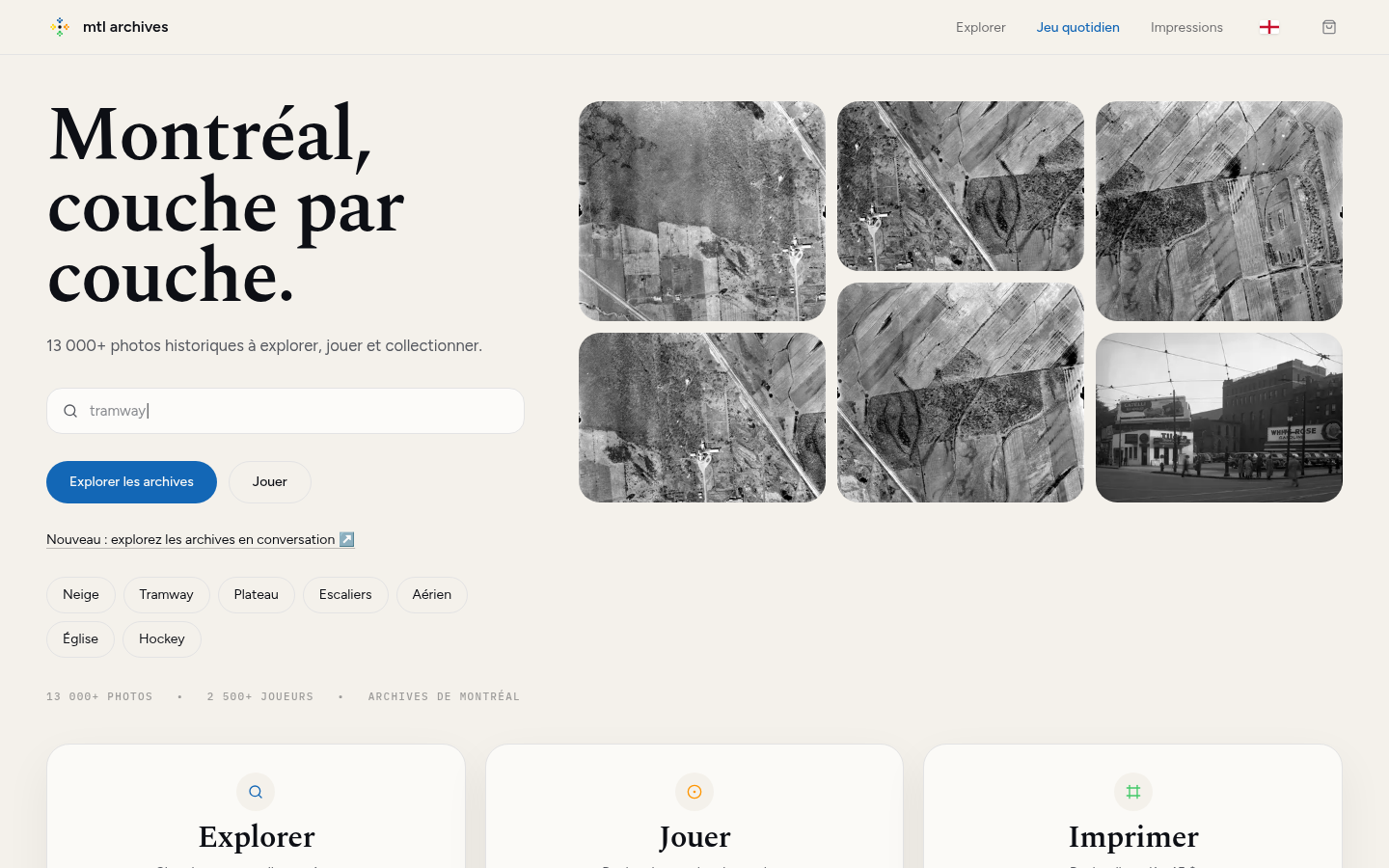
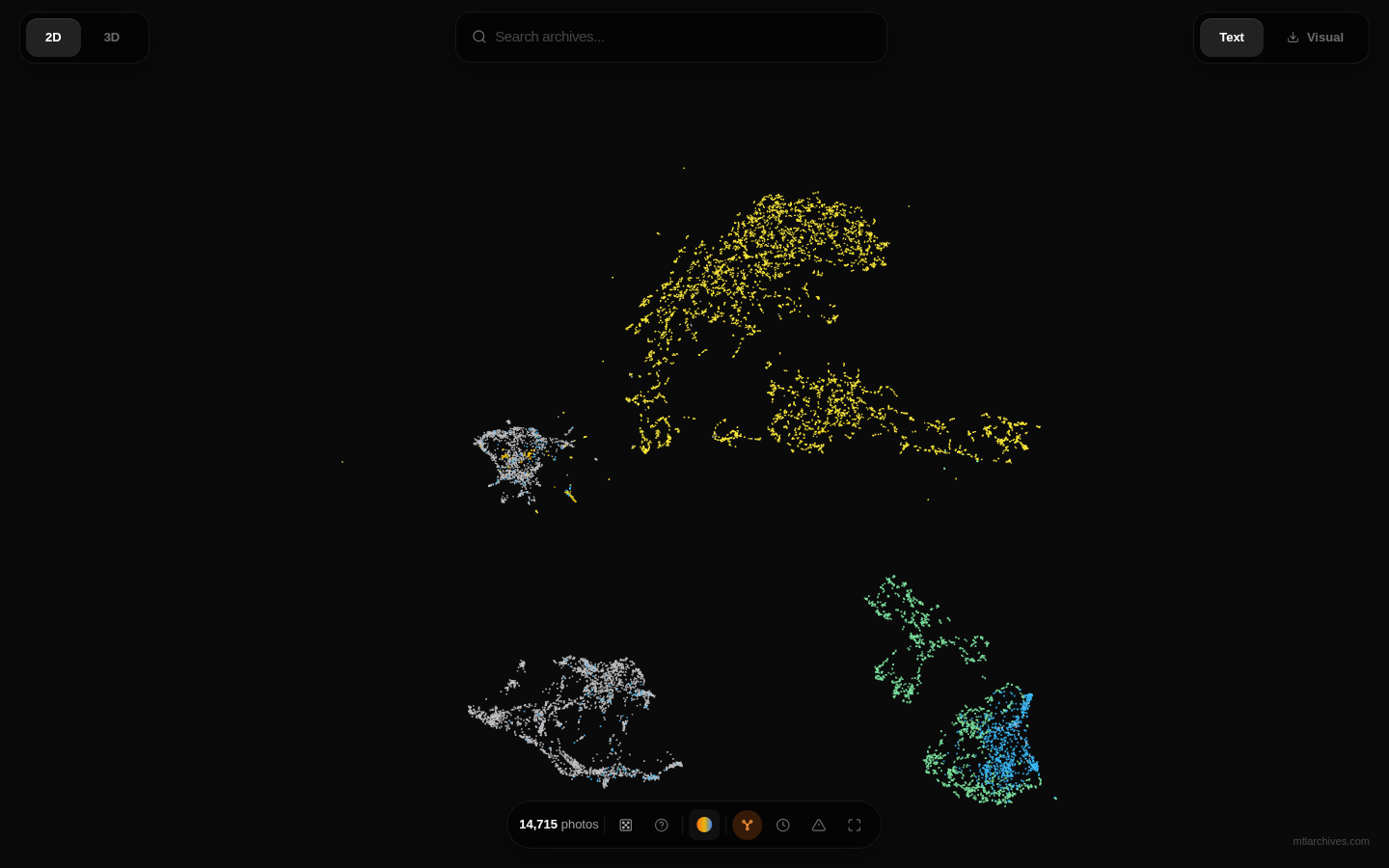
MTL Archives now supports several ways to search and browse the same collection.
The site includes search, visual similarity, a map of image embeddings, a daily location game, print ordering, and editorial workflows.
Website use and social views are measured separately. Social attention is not treated as attributed product conversion.
The interface is specific to Montréal.The workflow can be applied to other collections.
MTL Archives is specific to one city and its collections. The following work can be adapted elsewhere:
- 01
reconcile inconsistent source data,
- 02
preserve authoritative identifiers,
- 03
add generated information as a separate layer,
- 04
test retrieval rather than assuming a newer model is better,
- 05
provide more than one way to search and browse the collection,
- 06
and measure how those interfaces are actually used.
For another institution or design team, the interface and outputs may be different. The workflow starts with the collection and its intended use.
[ Discuss your collection]Want the implementation details?
The technical implementation documents the source data, reconciliation, enrichment, indexing, retrieval, product surfaces, and limits behind MTL Archives.